
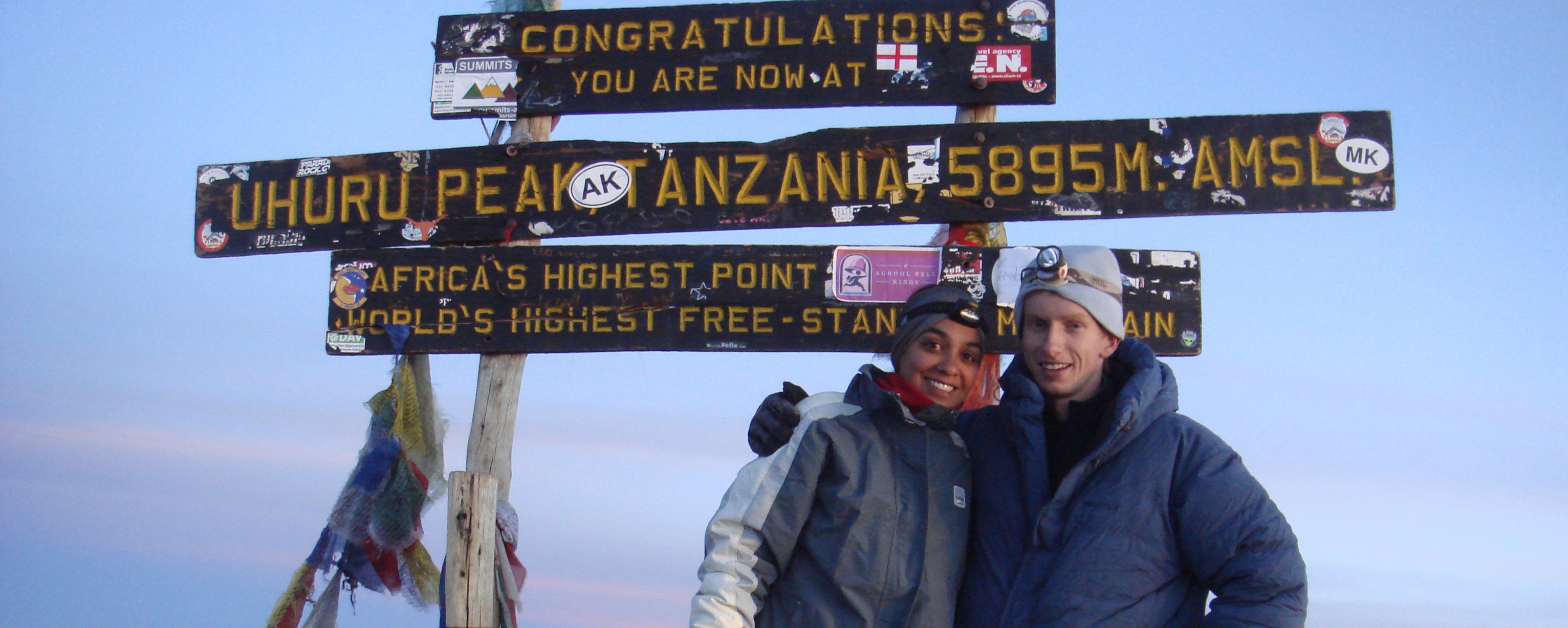
Seven intrepid explorers, one massive mountain, and a huge adventure – Rishi S reports back from a sponsored climb for Mukti Trust
Flying into Tanzania’s Kilimanjaro Airport clutching my passport, vaccination certificates and dollars, I realised the daunting task ahead. I had agreed to undertake a tremendous challenge with my family and friends to raise money for Mukti Trust.
It’s always good to start with a few facts: Kilimanjaro stands at a whopping 19,341 feet (or 5,895m). That’s equivalent to a 1,787-storey tower block, or 500m higher than Everest base camp.
Its name is believed to have originated from two words, ‘Kilima’ – Swahili for ‘hill, little mountain’ – and ‘Njaro’, thought to be an ancient Swahili word for ‘white’ or ‘shining’, and thus referring to the glacier.
The glacial coverage is one of the most beautiful aspects of the mountain. Unfortunately global warming is causing it to disappear at a phenomenal rate: between 1908 and 2007 more than 80% melted away, and it is currently receding by 2.5% a year. In 20 years time, there could be no ice left.
There are many routes up the mountain but all have a recurring theme (as the guides will happily tell you at every possible opportunity): ‘pole-pole’, meaning ‘slowly-slowly’. It was an important piece of advice; coming from regions of lower altitude we weren’t used to the reduced atmospheric pressure of high altitudes. We needed to conserve energy and allow our bodies time to adapt.
We trekked using the Rongai route – one of the most notoriously difficult, which in days gone by was plagued with bandits. We approached the start of the climb via a long, dusty and extremely bumpy four-wheel drive – obviously designed to weed out the weakest before we’d even begun.
Our first day involved a relatively short climb and camping after dark. That night, although cold, we all slept like logs – except for one person who insisted they kept hearing animal noises. Turns out they may have been right; according to our guides there were leopards and elephants in the area.
Our daily routine started early, with breakfast at 6am followed by a bowl of hot water for ‘washy-washy’, water sterilisation, and packing up our tents. We were on the move by 7 each morning. Hiking at a slow but steady pace, we drank fluids to lower our potential for altitude sickness. We usually reached the campsite around 2 or 3 pm, and were encouraged to continue hiking another 30 minutes up the trail to reduce signs of altitude sickness.
At the end of the fourth day we made the base camp – Kibo Hut – where altitude was 4700m. Until now we’d seen few other trekkers, but Kibo hut was where multiple routes collided, making it a busy spot.
By this point two members of our group were suffering symptoms of altitude sickness, including overwhelming nausea. We knew the next morning would be a long one, with the push to the summit being challenging to say the least.
The plan was to start ascending at 11pm so we could reach the summit for sunrise. We were on a shear shale face, in freezing cold and pitch blackness. We’d been advised to keep the water in our camel packs close to our skin, and the hoses tucked into our clothing, otherwise it would freeze.
There was no way of seeing how much further there was to go; each step forward would be met by an equivalent slip backwards of at least half that distance. And each time we asked the guides how much longer till the peak, we were met with the same answer of ‘one hour’, no matter how long since we’d last asked.
Three hours into this ordeal we lost another of our ranks, who headed back to base camp – head held high knowing he’d done everything he could to beat the mountain. My knee – which I’d strained on Day Two – was now in excruciating pain, but I was not giving up this close to the top.
Again we asked the guide for a time check, again we were told ‘another hour’ – and then, five minutes later, we were greeted by the summit. What a relief! We’d made Giliman’s Point – and then we discovered there was a further 90 minutes to the true peak of the mountain, Uhuru Peak.
Invigorated by the success of the hike so far, we set off. Unfortunately, another member of our team had to drop out at this point, thinning the numbers to four.
And then, finally, we reached Uhuru. The views were spectacular; the glaciers a brilliant white, almost blue (which I think by now I was too). The sense of achievement was astounding – it had been worth every bit of hardship to get here.
So we’d got up; now we had to get down. Knee supports were in abundance, walking sticks used by everyone – but we did it.
Back at the lodge, tired but happy, we showered, changed and chatted with our guide. Our time of six days – about average for ascending and descending Kilimanjaro – wasn’t bad, he said, but a lot slower than the record. That was achieved in 2006 by Simon Mtuy, a Tanzanian local, in 9 hours and 21 minutes. Wow. Who’s up for that challenge next time…?